











 Delhi
Delhi

Come Explore This #HiddenGem - Patteshah’s Dargah @ Nizamuddin


Bookmark
Sometimes you want to take a leap of faith, detach yourself from your anxious, questioning rational self, push aside all restraints of scepticism, sway to the rhythm of bells in a temple and just lose yourself in prayer. You want to listen to the regaling tales of Sufis and saints and mystics not like anecdotes, but as truths. You want to find your belief in them.
The long-winding stretch of road, from Humayun’s Tomb to Gurudwara Damdama Sahib, makes you shed all external accoutrements of urbanity and public-school education. You don’t want to question the existence of a God; you want to go in search of him.
The Dargah

At a stone’s throw away from Chilla Nizamuddin, barely noticeable at the bend of the road, is
an unpretentious, slim green door. There are no signboards, not many Namazis, but a line of alms-seekers in a state of stupor. They seek alms not in the name of Allah or Muhammad, but in the name of an entity called “barkatkaari”- he who showers “barkat”, well-being, prosperity & blessings.
Curious, you dutifully cover your head and enter the green door. At first sight you see nothing but a bare courtyard, and another green door on the far corner to the left. Next to that, is another ceremonious Mazaar, draped in green satin. You are standing in the compound of Patteshah’s Dargah, a contemporary of but 25 years elder than Hazrat Nizamuddin; with powers equally extraordinary, spirituality equally intense, but lesser known. The Hazrat would send many of his murids, and other troubled souls that flocked him, to Patteshah.
The Legend of Khwaja Shamshuddin
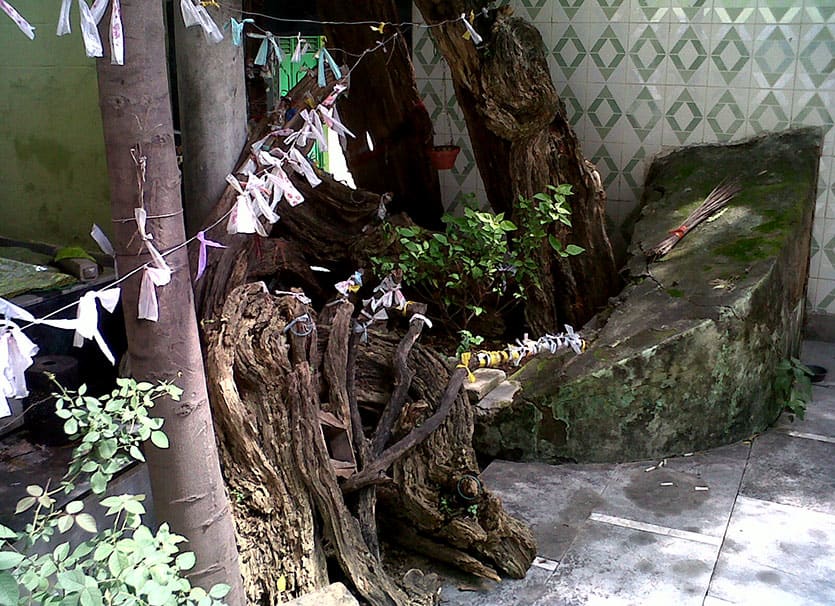
This was the actual name of Patteshah. What is now his Dargah, used to be his place of worship. The young, devout caretaker Maulvi will tell you that Khwaja Shamshuddin had planted a tree there, and once it grew, it had magical properties. If you chewed its leaves and made a wish, it would come true. This is actually a Meswak tree, called as “Peelu tree” by the devotees. That’s how he was given the title of “Patteshah”.
The trunk of the tree is bent and curved and intertwined with smaller branches. The Maulvi says that it is shaped to form the Arabic spelling for “Muhammad”. Nestled under the shade of the tree once planted by him, lies the last remains of the Khwaja.
The Other Mazaar
Unmarked, yet sacred to many, this mazaar is said to be of a pious old man and a devotee of both Hazrat Nizamuddin and Patteshah. Not hailed as a saint or seer, he was still believed to have prophetic premonitions. He was relatively more of our times, living in the 20th century, though the exact dates are not known. He once prevented a disciple from boarding an aircraft, which blew into flames only hours later.
For once, you don’t want to disbelieve. You don’t want your innate scepticism to ruin the unusual calm that has descended over you. You lead yourself to believe in all the magic, all the prophetic mysticism.
For once, you want to believe that there is indeed something that is beyond the grasp of the human mind; that can’t be tainted by human rationality. You reach out to the Peelu tree, pluck a few leaves and chew on them without rinsing.
Like
Bookmark
Share